

Daido Steel Co., Ltd. (President: Tetsuya Shimizu) has developed high power point source LED dies※1 in infrared (emission wavelength: 940 nm) and red (emission wavelength: 650 nm), achieving world class output power (Fig. 1).
By using these products, it is possible to improve the precision of position detection with LED based photoelectric sensors, enabling the detection of small objects and contributing to longer range, higher precision object detection.
This will contribute to higher precision photoelectric sensors, proximity and distance sensors for collaborative robots※2, and LED-LiDAR※3 for AGV/AMR※4 systems, all of which are expected to see growing demand in the coming years.
In addition, to improve our customers’ production efficiency in mounting processes, we have also developed surface mount devices (SMDs) in which these LED dies are encapsulated with transparent resin (Fig. 2).
Samples of the infrared point source LED dies and SMDs will be available from April 2026, while the red point source LED dies and SMDs will be commercially released starting in April 2026.
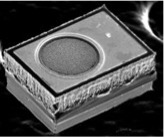
point-source LED
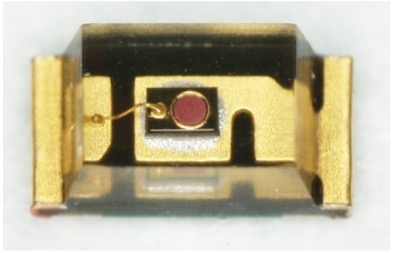
the SMD
| Peak emisson wavelength | Infrared(940nm) | Red(650nm) | ||
|---|---|---|---|---|
| Product type | Le die | SMD | LED die | SMD |
| Model | MED9P2 | MED9P2-SMF-5 | MED7P25 | MED7P25-SMF-5 |
| LID die Emitting window diameter(μm) |
φ150 | φ170 | ||
| Size (mm) Width×Depth×Hight |
0.36×0.28×0.15 | 0.16×0.8×0.7 | 0.365×0.265×0.15 | 1.6×0.8×0.7 |
1.Background
In recent years, labor shortages in manufacturing sites have accelerated the adoption of collaborative robots that can operate safely in the same workspace as humans, as well as AGV/AMR systems. As a result, high precision sensing is increasingly required to ensure worker safety and to prevent collisions involving robots and AGV/AMR systems.
These sensing applications widely use photoelectric sensors for distance detection. A photoelectric sensor measures distance by emitting light toward an object and determining the distance based on where the reflected light reaches the sensor. As the distance to the object changes, the position where the reflected light hits the sensor also shifts, allowing the sensor to determine the distance based on that position.
For this reason, point source LEDs that suppress light spread and form a small light spot are regarded as important light sources for improving distance and position detection precision in photoelectric sensors (Fig. 3).
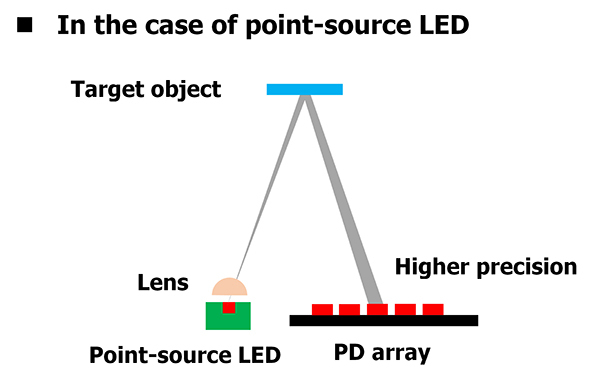
without light spreading
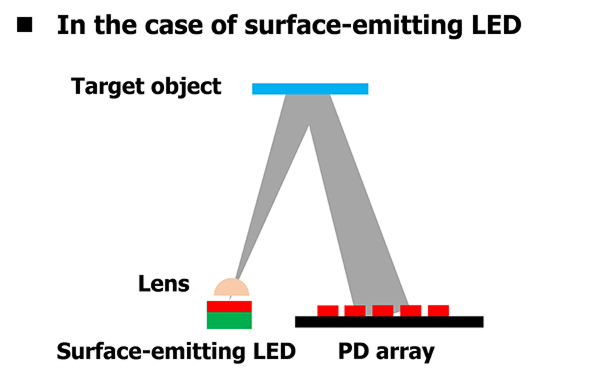
precision decreases.
Fig.3 Comparison of point-source LED and surface-emitting LED
Photoelectric sensors used for collision prevention in collaborative robots primarily employ invisible infrared light (with an emission wavelength of 940 nm), which does not cause glare to nearby workers. Furthermore, high-power LED dies and SMD packages are required for long distance detection, for preventing false detection caused by ambient light such as sunlight or illumination, and for stable detection of transparent or low reflective objects.
In photoelectric sensors used in semiconductor manufacturing equipment, red light (emission wavelength: 650 nm) is widely adopted because it facilitates optical axis alignment and sensor installation adjustments for high precision position detection, such as wafer positioning and alignment. Even for red point source LEDs, higher output power has been required to reliably detect small targets such as wafer edges.
To meet these requirements, we have developed the world’s first high power point source LED die and SMD with an emission wavelength of 940 nm. In addition, we have added a new high power point source LED die and SMD with an emission wavelength of 650 nm to our product lineup (Table 1).
2.Features
1)The MED9P2 achieves approximately three times higher output power than our current infrared point source LED (MED8P54, emission wavelength 855 nm, emitting window diameter Φ160 µm) (Fig. 4).
2)The MED7P25 achieves approximately 1.5 times higher output power than our current red point source LED (MED7P14C, emission wavelength 650 nm, emitting window diameter Φ160 µm) (Fig. 5).
3)By mounting these high power point source LED dies in a compact SMD package (JIS 1608M : W1.6 mm × D0.8 mm ×H0.7 mm), the package enables installation in confined spaces and offers greater design flexibility.
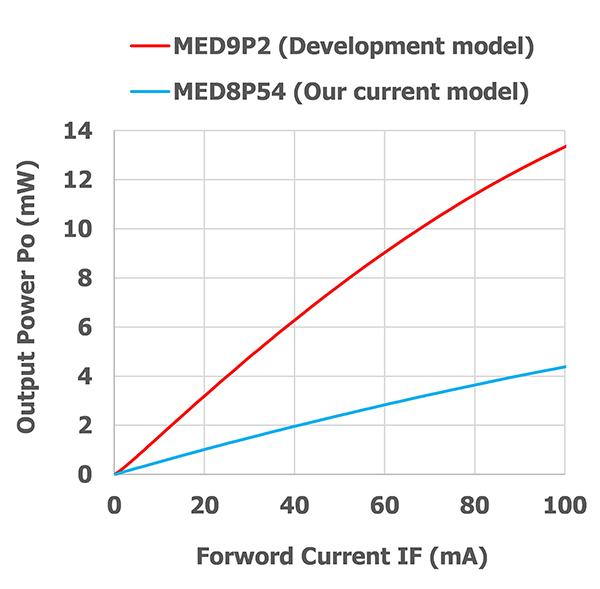
characteristics of infrared-LED (MED9P2)
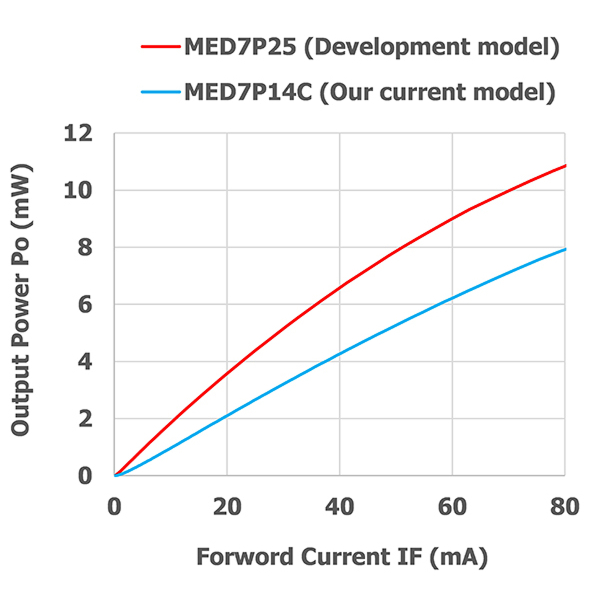
characteristics of red-LED (MED7P25)
3.Application
End applications:Collaborative robots, AGVs/AMRs,
Semiconductor manufacturing equipment, etc.
LED equipped applications:Photoelectric sensors, Distance sensors, LED-LiDAR, etc.
| ※1 Point-source LED | Unlike surface emitting LEDs, which emit light from the entire top surface, point source LEDs have a spot shaped light emitting window. In addition, surface emitting LEDs have a bonding pad located at the center of the die, which creates a shadow, whereas point source LEDs separate the light emitting window from the electrode pad, eliminating any shadowing. |
| ※2 Collaborative robot | An industrial robot that can work safely in the same space as humans. While conventional industrial robots operate in areas enclosed by safety fences, collaborative robots are equipped with safety features that detect contact with humans and stop them, allowing them to work cooperatively in the same workspace. This requires more delicate control. |
| ※3 LED-LiDAR | LED LiDAR (LED Light Detection and Ranging) is a distance sensor that uses an LED as its light source and calculates distance by measuring the time it takes for the reflected light to return from an object. |
| ※4 AGV/AMR | AGV (Automated Guided Vehicle) is a transport robot that automatically carries loads along pre defined routes. It is widely used in factories and warehouses to reduce labor requirements and improve safety. AMR (Autonomous Mobile Robot) is an autonomous transport robot that recognizes its surroundings with sensors and determines the optimal route on its own. Adoption is rapidly increasing in factories and logistics centers, driven by the need for labor savings in environments where humans and robots operate together. |